Shipping lines for a haul: weight, waiting time and tracking stages
A line is a carrier route with its own rules, limits and price. Read its name and notes before you pack, because they decide what can go in the parcel at all.
How agents name and group their lines
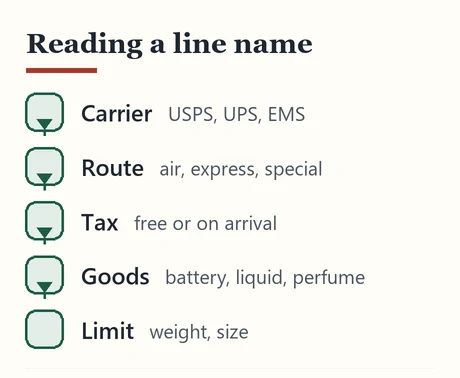
Agents sell international shipping as a list of lines, each one a combination of carrier, route and rules. The names are long because they carry information. Kakobuy's estimator on 10 October 2026, asked about a 1 kg parcel of ordinary goods to the United States, showed names such as "USPS Tax-Free Line (Battery Accepted)", "EUB (Batteries and Perfume Not Allowed)" and "Cosmetics Air Express (Battery, Liquid)". Read in that order, the names already tell you which line suits a haul with a power bank in it and which does not.
Lines change. They open, close and are re-priced from week to week, and some are only shown for certain destinations. That is why we do not reproduce price tables here; any figure we printed would be wrong within a month. Use the agent's own estimator on the day you ship, and copy the name of the line you chose onto your packing list. If something goes wrong later, the exact line name is the first thing an agent will ask for.
Actual weight, volume weight and the chargeable figure
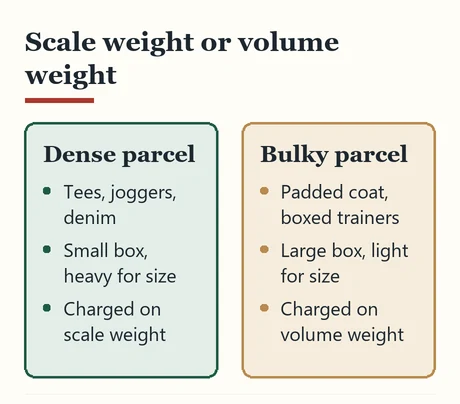
Couriers charge for space as well as mass. Most lines work out a volume weight from the parcel's length, width and height in centimetres, divided by a fixed number set by the carrier, and then charge whichever is higher: the actual weight on the scale or the volume weight. That higher figure is the chargeable weight.
For a haul, the consequence is that soft, dense items such as tees and joggers are charged roughly on their scale weight, while light, bulky items such as padded coats, trainers in boxes and structured bags are often charged on volume. One puffer can push a parcel from one regime into the other. The divisor differs by line and carrier, so the same parcel can have a different chargeable weight on two lines.
Weight also continues to be rounded upward in steps on many lines, so a parcel just over a step pays for the whole step. This is the strongest argument for a trial pack on a bulky haul: you see the packed dimensions before choosing.
Line notes that decide which items can travel
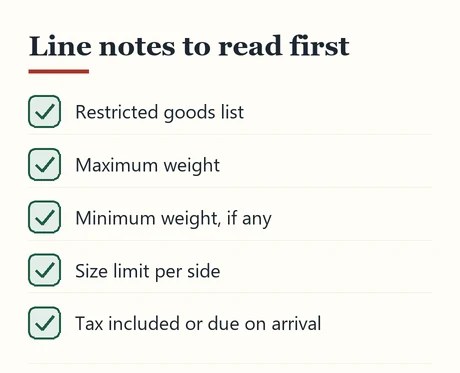
Beyond the name, each line has notes. They list restricted goods, minimum and maximum weights, and sometimes size limits. Kakobuy's estimator in October 2026 showed an EUB line to the United States with an actual weight limit of 2 kg, and several UPS lines with minimum weights, such as not less than 2000 g. A line with a minimum is no use for a small parcel, and one with a low maximum is no use for a big haul.
The practical routine is to choose the line before you finalise the parcel contents, not after. Take your docket, mark any line that holds perfume, liquid, a battery or anything magnetic, and filter the estimator for lines that accept those items. If none of the suitable lines suits the rest of the haul, that is your reason to split.
We do not attempt a list of what each country allows in. The agent's line notes, read on the day you ship, are the working reference, and they are written with the carrier's current rules in mind.
Tracking stages between the warehouse and your door
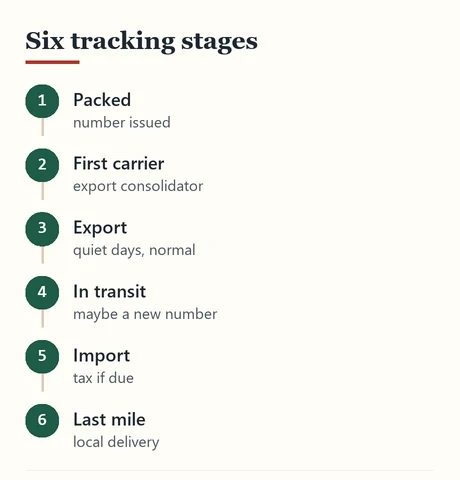
International tracking for a haul parcel usually passes through recognisable stages, even when each carrier words them differently:
- Packed and weighed at the agent warehouse; the agent issues the tracking number.
- Handed to the first carrier, often a consolidator that groups parcels for export.
- Export processing and a wait for space on a flight; this is where most quiet days happen.
- In transit abroad, sometimes with a hand-over to a second carrier and a second tracking number.
- Import clearance, where tax is assessed if the line does not include it.
- Last-mile delivery by a local postal service or courier.
Note on your docket the date of each stage change. If tracking stops for longer than the agent's published guidance for that line, write to the agent with the parcel number and the line name, not to the local courier, because the agent holds the contract with the first carrier.
Customs and tax, without the rulebook
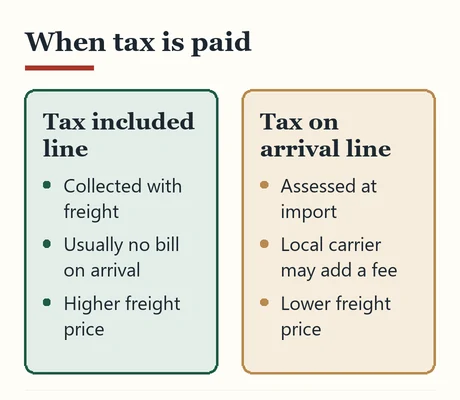
Whether you pay import tax, and how much, depends on where you live, and the rules change. We do not try to summarise them. What you can control is whether tax is handled before the parcel leaves or when it arrives. Line names often say so: "tax-free", "tax included" or "duty-free" lines collect the tax in the freight price, while ordinary lines leave it to be assessed on import, sometimes with a handling charge from the local carrier.
Agents also publish notices when tax arrangements change. Kakobuy's notice of 23 June 2026 said that parcels to the EU would be charged a flat €3 per parcel at submission, regardless of how many product categories were inside, and could be withdrawn with notice; its duty-free EU lines were described as including all applicable taxes and duties.
We give no advice on what to write on the customs declaration. Fill in the agent's form truthfully and follow your own country's rules; if in doubt, ask the agent what its form requires.
Insurance and what a claim asks of you
Parcel insurance is bought per parcel, usually at submission, and its terms vary more than anything else in this guide. Kakobuy's help centre describes three parts: delay insurance, paying 20% of the shipping fee if a parcel takes more than 30 or 40 days from shipment depending on the route; customs hold cover; and loss or damage cover, capped at the actual shipping fee plus the goods' value up to the insured amount. RizzitGO's route texts on 14 lines say claims must be made within 15 days of delivery or within 30 days of the last tracking update, and late claims are not accepted.
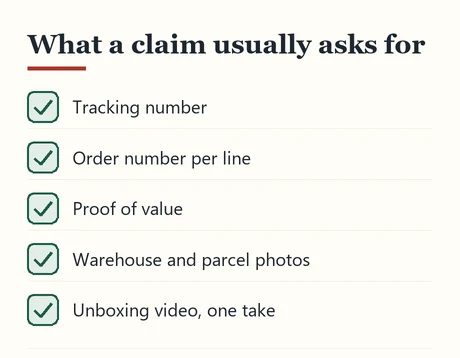
What a claim asks of you is fairly consistent. LoongBuy's FAQ lists the tracking number, the order number, proof of the product's value, photos, an unboxing video and logistics proof. Nearly all of that is produced by keeping a docket: the order numbers are on your lines, the warehouse photos show what was packed, and the doorstep count produces the unboxing video.