Choosing sellers and catalogue sites before a haul, and the traps to avoid
Most haul trouble is decided before anything is paid for: by which sellers you pick, which catalogue you trust and how you write the order down.
How to choose a seller for a multi-item haul
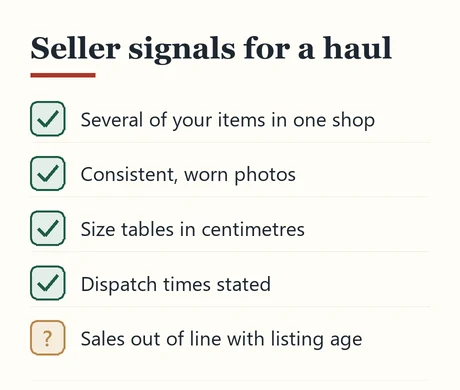
For a single item, a seller only needs to send the right thing. For a haul, a seller also sets your waiting time and your domestic postage. Signals worth reading on a seller's shop page:
- Several items you want in one shop. Items from one seller checked out together usually travel in one domestic parcel with one postage charge.
- Consistent photos across the shop. A shop whose listings share a photo style and real worn shots is more likely to be sending its own stock.
- A size table on every listing, in centimetres, rather than letter sizes alone.
- Stated dispatch times and no long pre-sale periods on the options you need.
- Sales and reviews that match the listing's age. A brand-new listing with a huge sales figure deserves a second look.
Good sellers are the ones you go back to. After a haul, mark on your docket which sellers sent quickly and accurately; next time, start your shortlist from their shops.
Telling a kept catalogue site from an abandoned one
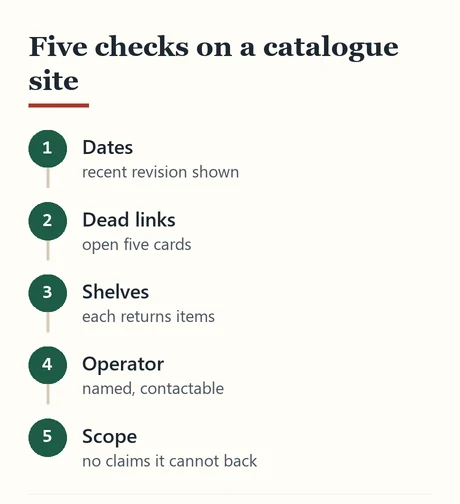
How to judge a Spreadsheet site comes down to evidence of upkeep. Catalogue sites go stale quietly. Listings disappear, sellers close and links rot, and a catalogue nobody maintains keeps looking busy long after it stops being useful. Concrete checks:
- Dates. Does each page say when it was last revised, and is that date recent?
- Dead links. Open five cards at random. If more than one leads nowhere, the catalogue is not being checked.
- Shelves that return items. Every category link should open a shelf with listings on it, not an empty page.
- A named operator and a contact address, and a plain statement of any referral relationship with agents.
- Honest scope. A catalogue that claims to have checked quality it never saw, or promises outcomes for items it does not sell, is telling you something about the rest of its content.
Apply the same checks to this site. Our updates page lists what changed and when, and every page carries its revision date in the footer.
What this catalogue guide adds, and its upkeep
This site does one thing other catalogue guides mostly leave out: it treats a haul as a sequence of counts, and gives you a tool and a page for each. The catalogue cards and category links come first because that is where a haul starts; the counting pages follow because that is where hauls go wrong.
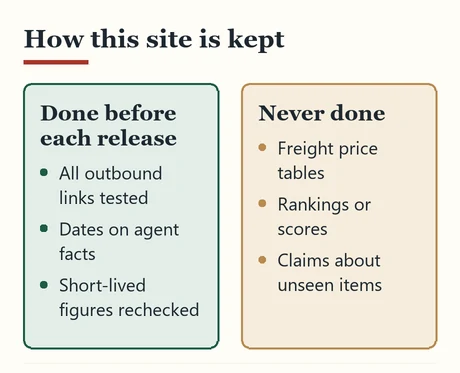
How it is kept: every outbound link, including every category card, is requested by a link checker before each release, and a link that fails is fixed or removed before the pages go out. Facts about agents carry the date of the page they came from, and figures with a short shelf life, such as storage terms and fees, are listed internally with a recheck date. We do not host product pages, do not copy listings and do not describe items we have not seen.
What we do differently is also what we leave out: no freight price tables, no rankings and no promises about any seller. Where the published facts run out, the page says so.
Mistakes that break a haul count
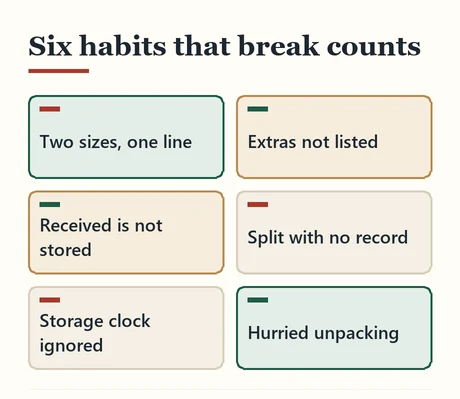
Most broken counts trace back to one of a handful of habits. Watch out for these:
- One line for two sizes. Ordering M and L as a quantity of two on one line means the photos cannot be matched to the docket.
- Unrecorded extras. A strap, a pouch or a gift that is not on the docket looks like a surprise at the door, or worse, goes unnoticed when missing.
- Counting received as landed. A parcel at the warehouse is not a checked item until it is stored and photographed.
- A split haul with no split record. Two parcels and no note of which lines went where is the most common way a line vanishes.
- Waiting past the storage clock for one slow item while the oldest line runs out of free days.
- Unpacking in a hurry, without a video or a layout photo, then trying to claim a missing piece a week later.
Before you pay for anything
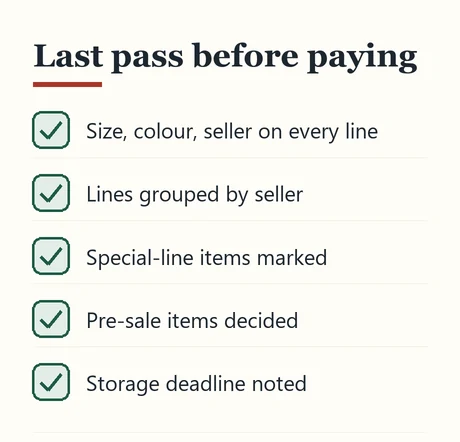
A last pass before the first payment avoids most of the traps above. With the docket in front of you:
- Check every line has a size, a colour and a seller.
- Group lines by seller and see whether any seller can supply one more item you wanted, to share the domestic postage.
- Mark lines that may need a special shipping line, such as perfume from the perfume shelf or anything with a battery.
- Look for pre-sale options and long dispatch times, and decide whether they belong in this haul or the next.
- Read the agent's storage terms and note the date by which the oldest line must ship.
- Note the exchange rate and payment fee you are about to pay.
None of this takes long, and every item on the list removes a reason for a count to break later.