
Mulebuy Spreadsheet: a haul docket for what you pick, what lands and what reaches your door
Pick finds from the catalogue below, then keep one running count as they pass from seller to warehouse to parcel to your hallway. Most haul problems first show up as a number that stops matching.
English search words work best. Every result card shows the listing price in yuan and the shelf it sits on.
Shelves most hauls are built from
All sixteen shelves, with a note about what each item changes in your haul. Read the category guide before adding it to the docket.
 Coats and jacketsThe bulkiest line in most hauls, so settle it before anything else.Category
 TrainersWhen photos arrive, count pairs and boxes as two separate things.Category
 DenimRead the waist and length figures for each size option, not the label size.Category
 Hooded topsFleece weight shows up on the warehouse scale, not in the listing title.Category
 Bags and totesCount the bag, the strap and any pouch as separate pieces.Category
 JoggersThey fold flat and fill the gaps around stiffer items in a mixed parcel.Category
 TeesOrder each size as its own line so every photo can be matched.Category
 Hats and beaniesSmall and soft; they vanish in a big box, so count them first.Category
 Womenswear searchSearch results cross several product categories.Category
 Sports jerseysConfirm the cut and any name or number printing.Category
 BeltsMeasure to the middle hole, not the full strap.Category
 EyewearCheck frame width; a photo cannot prove UV protection.Category
 JewelleryCheck dimensions and the stated metal.Category
 WatchesAsk about movement and battery restrictions.Category
 PerfumeConfirm liquid acceptance before ordering.Category
 ElectronicsCheck battery, plug and model compatibility.Category
What this Mulebuy Spreadsheet is, and the docket idea behind it
A Mulebuy Spreadsheet is a product catalogue: shelves of cards, each card showing one listing drawn from Taobao, Weidian or 1688 (the big Chinese marketplaces), with its photo, its title and its price in yuan. You browse by category, open a card, and carry the listing link to a buying agent, which purchases the item for you and posts it on. It is a shop window you can search, not a document you scroll through.
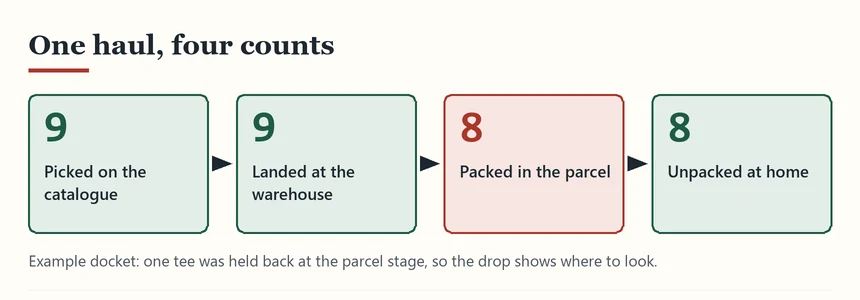
- Count onePickedThe lines you chose on the catalogue, with size and colour.
- Count twoLandedWhat the warehouse logged and photographed.
- Count threePackedWhat went into each outbound parcel.
- Count fourUnpackedWhat came out of the box at home.
The four counts give the menu its shape. Read them in order for a first haul, or jump straight to the stage you are stuck at.
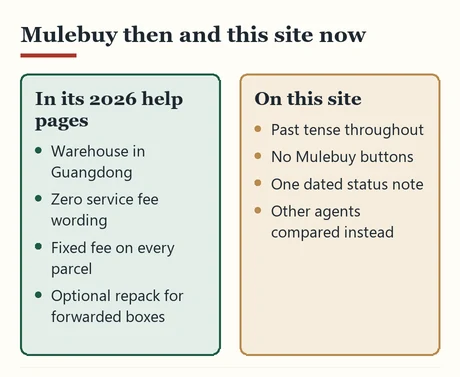
Mulebuy itself, written in the past tense
Mulebuy was a buying agent with a warehouse in Guangdong province; its August 2026 help pages placed that warehouse in Huizhou. The catalogue still carries its name because that is the name many shoppers typed into a search bar when they first heard about buying through an agent.
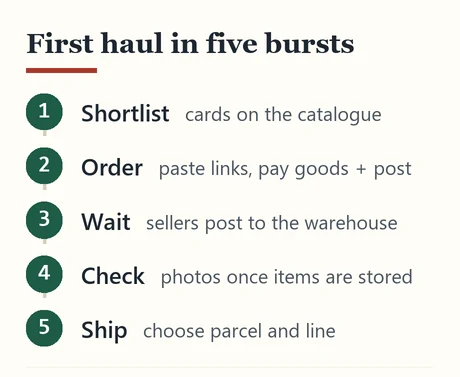
A first haul, from catalogue card to stored item
The first haul is mostly waiting, with five short bursts of attention in between. You shortlist cards, paste each listing link into an agent's order form, pay for the goods plus the seller's domestic postage, and then wait while sellers post to the agent's warehouse. Items are received, weighed, photographed and finally marked as stored. Only then do you choose what goes in the parcel.
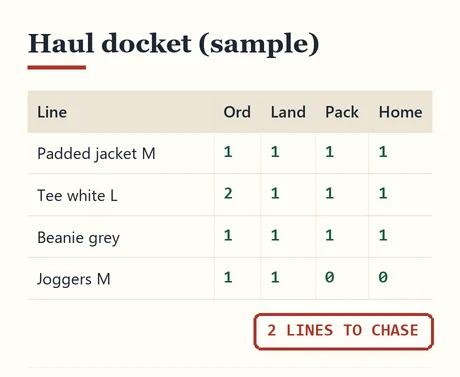
The docket tool, and what it is for
The haul docket tool is a small form that runs in your browser. Enter each line of your haul once, then fill in four numbers as the haul moves: ordered, landed at the warehouse, packed, unpacked. The tool lists every line where a number drops or grows, says which stage it happened at, and suggests who to ask. It keeps your docket in the browser between visits and can copy it as plain text for a message to an agent.
Follow the haul at each handoff
Count one happens in a Chinese warehouse
When your items land, the warehouse sends photos. This is the first count, and it is the only one that happens while the seller can still be asked to fix something.
Count two: what goes into the outbound parcel
Consolidation is the agent's word for putting several stored items into one outbound parcel. It sounds simple, yet this is where items are most often left behind: the last arrival is still on its way, an item is held because of a line restriction, or you split the haul across two parcels and forget which line went where.
Lines, weight and the waiting time
Agents call each shipping option a line, and the line name often tells you what it will refuse. Kakobuy's estimator in October 2026, for example, listed lines with names such as "EUB (Batteries and Perfume Not Allowed)" and "USPS Tax-Free Line (Battery Accepted)".
Count three, on your own doorstep
The last count is yours alone. Before you sign, look at the outer carton; LoongBuy's FAQ advises checking that it is intact and, where needed, opening it on the spot and keeping the carton, tape, photos and video in case of a claim.
What a haul costs, line by line
An agent bill is a stack of separate charges: the listing price, the seller's domestic postage, any service fee, per-parcel fees, optional add-ons such as extra photos or reinforced packing, international freight and, depending on where you live, import tax. Some of these grow with every item and some are charged once per parcel, which is why one set of items can come to quite different totals packed as one parcel or as two.
Agents you can hand a haul to this autumn
We compare four agents that were taking orders when we checked in October 2026: LoongBuy, RizzitGO, Superbuy and Kakobuy. The comparison sticks to three haul questions with published answers: how long items stay in storage for free, whether you can pay for a trial pack before freight, and how many photos you get when an item arrives.
Sellers, catalogue sites and the usual traps
A haul with ten lines from ten sellers behaves differently from ten lines from two sellers. Fewer sellers usually means fewer domestic postage charges and fewer arrival dates to wait for; several agents, Mulebuy among them in its May 2026 help pages, charged domestic postage once when several items from the same seller were checked out together.
Help, plain-English terms and the change log
Agent screens use their own vocabulary: stored, abnormal parcel, rehearsal, waybill, GL and RL. The help page explains each term the way a haul uses it, answers the questions people ask most often, and says what to include when you write to an agent so the reply comes back faster.