What a haul costs: goods, domestic post, freight and the exchange rate
No single figure here is large. The surprise comes from how many separate charges a haul collects, and from which ones are paid per item and which per parcel.
The lines on an agent bill
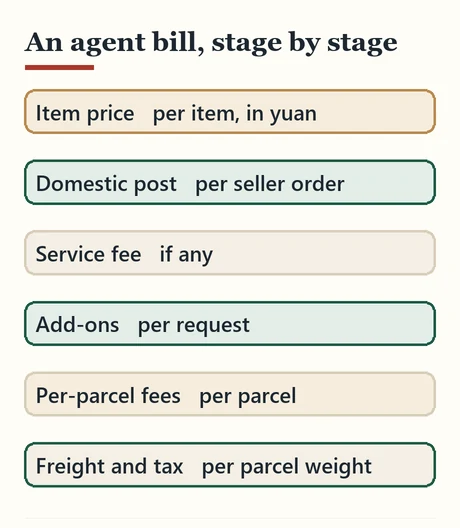
An agent bill for a haul is built from separate charges, and it helps to know which stage each one belongs to:
- Item price, exactly as the seller lists it, in yuan.
- Domestic shipping fee, the seller's postage to the agent warehouse, usually once per seller order.
- Service fee, if the agent charges one for buying on your behalf.
- Add-ons such as extra photos, measurements, video or special packing.
- Per-parcel fees charged at submission, whatever the parcel holds.
- International freight, set by the line and the chargeable weight.
- Import tax, either collected with freight or assessed on arrival.
The service fee line has become small or zero at many agents, but rarely means the bill has nothing on it beyond goods and freight. LoongBuy's FAQ describes a 0 service fee mode, with value-added services charged when chosen. Superbuy charges no purchasing service fee on mainstream platforms such as Taobao, Tmall, JD.com and 1688, but a flat CN¥20 per order on second-hand platforms such as Xianyu. Mulebuy's August 2026 help pages called zero service fee its philosophy, yet still pre-collected a baseline customs declaration fee on every parcel.
Per-parcel charges that do not shrink with a bigger haul
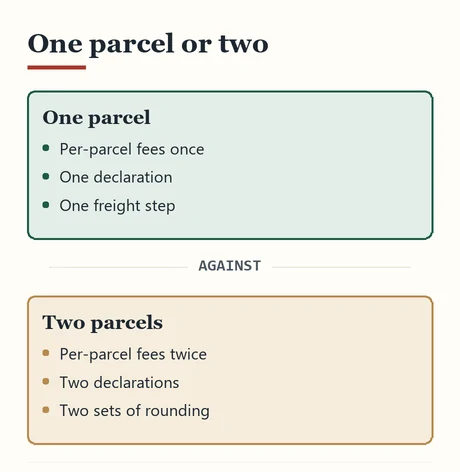
Some charges are fixed per parcel. They are why a haul usually costs less in one parcel than in two, and why sending a single small item on its own is often poor value.
- Kakobuy lists an ¥8 charge per parcel, which one help page calls a packaging consumables fee and another calls a customs declaration fee. Same eight yuan, two names.
- Superbuy gives a customs declaration cost of generally RMB 8.00 per parcel, depending on the shipping method.
- Mulebuy, in its August 2026 FAQ, pre-collected a baseline customs declaration fee on every parcel, alongside its zero service fee wording.
- Kakobuy again, in June 2026, began collecting a flat €3 per EU parcel at submission.
When two agents look equal on item price and freight, per-parcel charges can decide it, especially if you expect to split a haul. Count how many parcels your docket implies before comparing.
Storage after the free period
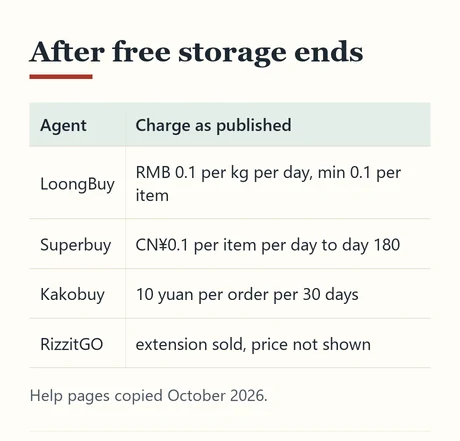
Storage is free until it is not, and the charge that follows is calculated differently at each agent. As published in October 2026:
- LoongBuy charges per item by chargeable weight after 90 days: RMB 0.1 per kilogram per day, with a minimum of RMB 0.1 per item per day, and a total storage limit of 180 days. Its example: an item with a chargeable weight of 1 kg costs RMB 0.1 per day.
- Superbuy charges CN¥0.1 for each item and each day between day 91 and day 180, collected at parcel submission, or sells an extended storage period at CN¥10 a month. Its own example: two items stored for 100 days cost 2 yuan.
- Kakobuy sells an extension at 10 yuan per order for each 30 days.
- RizzitGO sells extensions from the warehouse screen but does not publish their prices.
For one haul these amounts are small. The real cost of overrunning is the hard limit behind them: at 180 days, or when an extension lapses, unsubmitted goods may be treated as abandoned.
The yuan rate behind every top-up
Agents price everything in yuan, and most show a converted figure in your currency next to it. The conversion is where a quiet cost sits. The rate an agent uses for top-ups and payments is its own, and it is usually less favourable than the mid-market reference rate quoted in the news or by currency sites. Your card or wallet may then convert again with its own margin if you pay in a currency the agent does not hold.
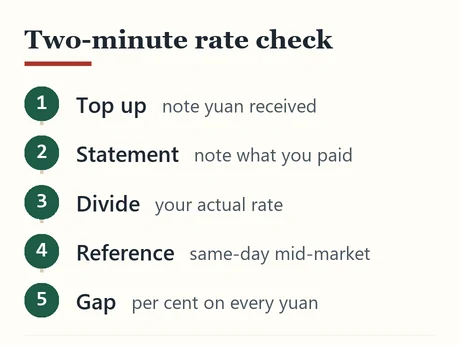
A simple check takes two minutes. On the day you top up, note the yuan amount and what you were charged in pounds, euros or dollars, then divide to get the rate you actually paid. Compare it with a reference rate for the same day. The gap, as a percentage, applies to every yuan of the haul: goods, domestic post and freight.
Write that percentage on the docket. Across a few hauls it tells you more about an agent's real price than any single fee line.
Payment fees by method
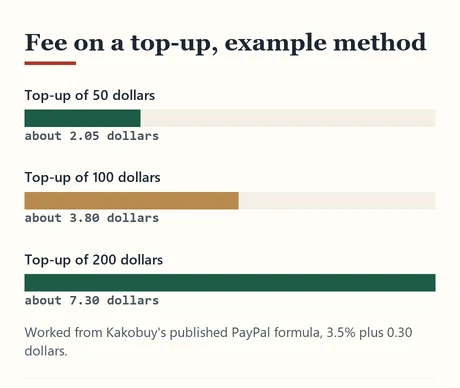
The way you pay can add its own charge. Agents publish these unevenly; some show a formula, some only show the fee at checkout. One clear example: Kakobuy's help centre, in a copy from 10 October 2026, listed a PayPal handling charge of 3.5% plus US$0.30, and no handling charge for Alipay or WeChat.
Because handling charges are often a percentage, they grow with the size of the top-up, while a fixed part favours fewer, larger payments. For a haul, that suggests topping up once for the goods and once for freight, rather than paying each line separately with a card.
Look for the fee on the payment screen itself before confirming, and note it on the docket next to the top-up amount. Added to the exchange-rate gap, it gives the full cost of getting your money into the agent's balance.
If an agent shows no fee for a method, compare the amount debited on your statement with the amount credited to your balance; any gap is the real fee.
Paying for freight twice: estimate, then settle
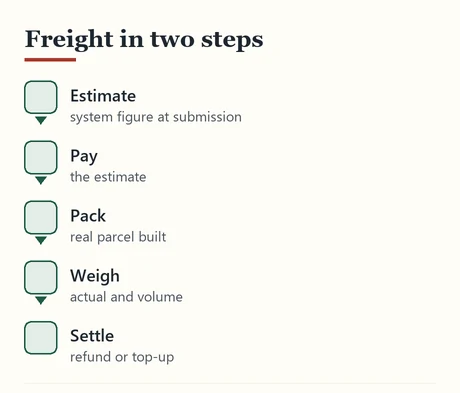
Freight is usually paid in two steps, because the real figure only exists once the parcel is packed. LoongBuy's policy sets out the common pattern: pay the estimated freight shown by the system at submission, let the warehouse pack and weigh the parcel, then receive a refund of any excess or a request to pay any shortfall.
Superbuy's Shipping Expert service turns that around for parcels it handles: the experts work out the parcel data first and apply a rule of refunding any excess with no supplementary payment for a shortage, though remote-area surcharges and customs duties sit outside that promise. A trial pack, described on the parcel count page, does a similar job at other agents.
On the docket, record the estimate and the settled figure for each parcel. The difference, haul after haul, shows how well your own guesses about bulk match the warehouse scale.